SpaceFX (Stereo)
Description
The idea of SpaceFX is to have a simple yet flexible to control white noise and modulated filter self oscillation generator. SpaceFX among other things tries to pay tribute to early space-rock bands like Gong, Hawkwind, Far East Family Band and others. But also the Radiophonic Workshop and electronic works by Ligeti or modern glitchy or soundscape-oriented stuff comes to mind. A major inspiration being Tim Blake’s usage of the VCS 3 for such “space noises”.
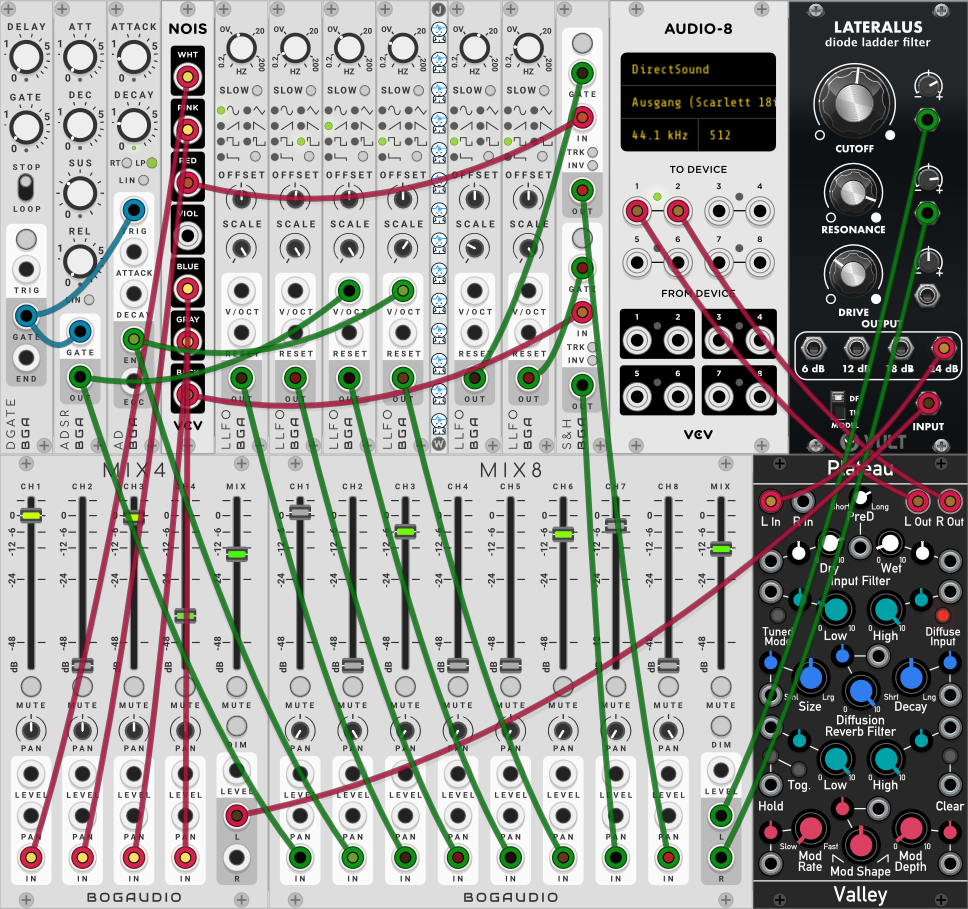
The plugin uses a diode-ladder filter and a sawwaves oscillator by Carlos Laguna Ruiz implemented in his VULT language, for more details on the topic please look here: https://github.com/modlfo/vult VCV-Rack prototype for SpaceFX using a similar VULT-filter:
Parameters
Section 1: Global
Trigger/Gate Envelopes
Master Pitch (map CV to Cutoff here if desired)
Master Tune +- 1200 Cent
Filter key tracking (Pitch-CV to Cutoff)
Volume before Effects
Section 2: Voice / Noise
Enable Noise n/y
Noise Colour (Pink to White)
Noise Level
Modulate Noise n/y
Noise Colour Mod Speed
Noise Colour Mod Amount
Noise Level Mod Speed
Noise Level Mod Amount
Section 3: Voice / Filer
Enable Pitch to Cutoff n/y
Cutoff Frequency
Resonance
Use vintage resonance tuning n/y
Cutoff Modulation Level (EGs+SOU+LFOs)
Resonance Modulation Level (EGs+SOU+LFOs)
Amplitude Modulation Level (EGs+SOU+LFOs)
Section 3: AD Envelope
AD envelope active n/y
AD envelope modifies VCA level n/y
AD Attack
AD Decay
AD envelope loop n/y
AD volume envelope invert n/y
AD envelope cutoff amount
AD envelope resonance amount
AD to Saw LFO speed n/y
AD to Saw LFO speed amount
Section 4: ADSR Envelope
ADSR envelope active n/y
ADSR envelope modifies VCA level n/y
ADSR Attack
ADSR Decay
ADSR Sustain
ADSR Release
ADSR volume envelope invert n/y
ADSR envelope cutoff amount
ADSR envelope resonance amount
ADSR to Sine LFO speed n/y
ADSR to Sine LFO speed amount
Section 5: SOU - Source of Uncertainty (SnH1: Whitenoise-Based, SnH2: Pinknoise-based)
SAMPLE AND HOLD LFO 1 active n/y
Sample n’ Hold 1 frequency
Sample n’ Hold 1 cutoff level
Sample n’ Hold 1 resonance level
Sample n’ Hold 1 AM level
Sample n’ Hold 1 to Frequ. of SnH-1
Sample n’ Hold 1 to Frequ. of Square LFO
Sample n’ Hold 1 to AD Attack
SAMPLE AND HOLD LFO 2 active n/y
Sample n’ Hold 2 frequency
Sample n’ Hold 2 cutoff level
Sample n’ Hold 2 resonance level
Sample n’ Hold 2 AM level
Sample n’ Hold 2 to Frequ. of SnH-1
Sample n’ Hold 2 to Frequ. of Pulse/Tri LFO
Sample n’ Hold 2 to AD Decay
Section 6: LFO Modulation Mixer (Cutoff, Resonance and Amplitude Modulation)
SINE LFO active n/y
Sine frequency
Sine LFO cutoff level
Sine LFO resonance level
Sine LFO AM level
Pulse LFO active n/y
Pulse frequency
Pulse Width
PWM speed
PWM Oddness factor
Pulse/Tri LFO cutoff level
Pulse/Tri LFO resonance level
Pulse/Tri LFO AM level
SAW LFO active n/y
Sawtooth frequency
Sawtooth LFO cutoff level
Sawtooth LFO resonance level
Sawtooth LFO AM level
SQUARE LFO active n/y
Square frequency
Squarewave LFO cutoff level
Squarewave LFO resonance level
Squarewave LFO AM level
Section 7: Delay
Delay active n/y
Shorten Delay Times to 0.5 seconds n/y
Delay Time (max. 0.5 or 2 Sec.)
Delay Feedback
Delay Dry/Wet
Section 8: Reverb (Set to Mono if you want to use only one output of the TBD)
Reverb active n/y
Mono Reverb n/y
Reverb Input Gain
Reverb Diffusion
Reverb Time
Reverb Lowpass
Reverb LFO 1
Reverb LFO 2
Reverb Dry/Wet
Usage / Patch Ideas
There are various main modes of operation:
- “Space Noises” using modulated self-oscillating filter tones
only
- Like (a) but also involving noise, filter tones can be
self-oscillating but don’t have to
Using AM for Ring Modulator kind of tones
Like (a) and/or (b/c) but with an volume envelope applied
Using vast Echo and/or reverb for soundscapes
- Making use of the cross-modulation options of the EGs and SnH
LFOs to generate self-playing patches. A typical Todd Barton inspired Krell patch like explained here by himself is possible: https://vimeo.com/48466272
The general idea here is, then to find some “sweet spots” where the “Space Noises”sound interesting and then play around with some parameters in a way that makes sense in the (musical) context you want to use it. The filter also may be played via CV/Gate by a keyboard, thus becoming an oscillator on its own. VCV Rack was used for prototyping, as you can see in the screenshot above, the module Plateau got used, whereas SpaceFX uses a Mutable Instruments Reverb plus a simple yet (literally) effective feedback-delay line.